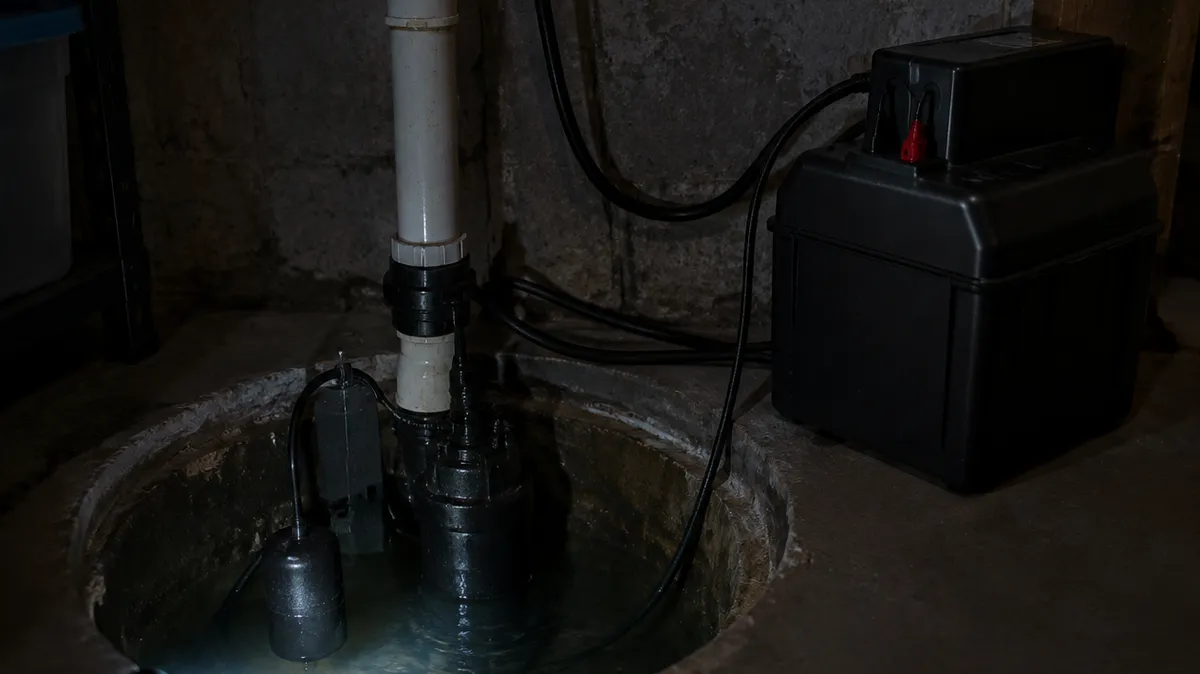
News explainer · Published October 12, 2026

A standard sump pump runs on household electricity. When a storm knocks out the power, the pump can stop at the moment the pit is filling fastest. The problem is predictable, and so are the fixes.
Key takeaways
Heavy rain raises groundwater and fills the sump pit. Severe storms are also what knock out power lines. The two often arrive together, which is why an outage is one of the more common reasons a pump fails to do its job. Our guide to why sump pumps stop working covers the other causes, from stuck floats to clogged discharge lines.
A pump with a good float and a clear discharge line still can’t run without power. That’s a different failure from a worn-out pump, and it needs a different fix.
| Option | What it does | What to check |
|---|---|---|
| Battery backup pump system | A second pump and battery take over when mains power or the main pump fails. | Battery type and capacity, expected runtime under continuous pumping, how it’s charged, and a test routine. See our battery backup comparison. |
| Portable generator | Powers the main pump during an outage. | Wattage the pump needs to start, safe outdoor placement, fuel on hand, and a safe way to connect it. Ask an electrician before wiring anything. |
| Water alarm | Warns you if the pit or floor is getting wet. It doesn’t pump. | Battery-powered unit, loud local alarm, optional phone alerts if your Wi-Fi stays up. See our basement water alarm guide. |
These stack. A battery backup handles the first hours, an alarm tells you if it isn’t enough, and a generator covers a longer outage.
People reach for a generator in a storm and run it too close to the house. The Consumer Product Safety Commission is direct about this: never operate a portable generator inside a home, garage, basement, crawlspace or shed. Run it outside, at least 20 feet from the house, with the exhaust pointed away from the home and other buildings, and keep windows nearby closed. A porch or carport is too close.
CPSC also recommends battery-operated or battery-backup carbon monoxide alarms on each level of the home and outside sleeping areas. If one sounds, get outside and call 911.
Don’t run a generator in a flooded basement, and stay out of standing water near electrical equipment. If the basement is already wet, call a professional.
Standard homeowners policies generally exclude water that backs up through drains and often sump pump overflow. An optional water backup endorsement adds that coverage, usually with a limit. Flood insurance, including the NFIP, covers water entering from outside and doesn’t cover sewer backup. Our sewer backup coverage guide explains the differences, and the sump pump vs. waterproofing explainer covers what a pump alone can and can’t do.
This is general information, not insurance advice. Ask your agent what your policy says about sump failure and power outages.
FAQ
A standard pump stops, because it runs on household electricity. If groundwater is rising at the time, the pit can fill and overflow unless you have a battery backup, a generator or another way to keep pumping.
It depends on the battery, the pump and how often water enters the pit. Manufacturers publish runtime estimates, but check the conditions behind them and treat them as estimates.
Many people do, but check the pump's starting wattage and ask an electrician about a safe connection. Run the generator outdoors at least 20 feet from the house, never in a garage, basement or shed.
No. An alarm warns you but doesn't remove water. It works best alongside a backup pump.
Often not by default. Standard policies generally exclude sump overflow and drain backup unless you add a water backup endorsement. Check your policy wording and limit.