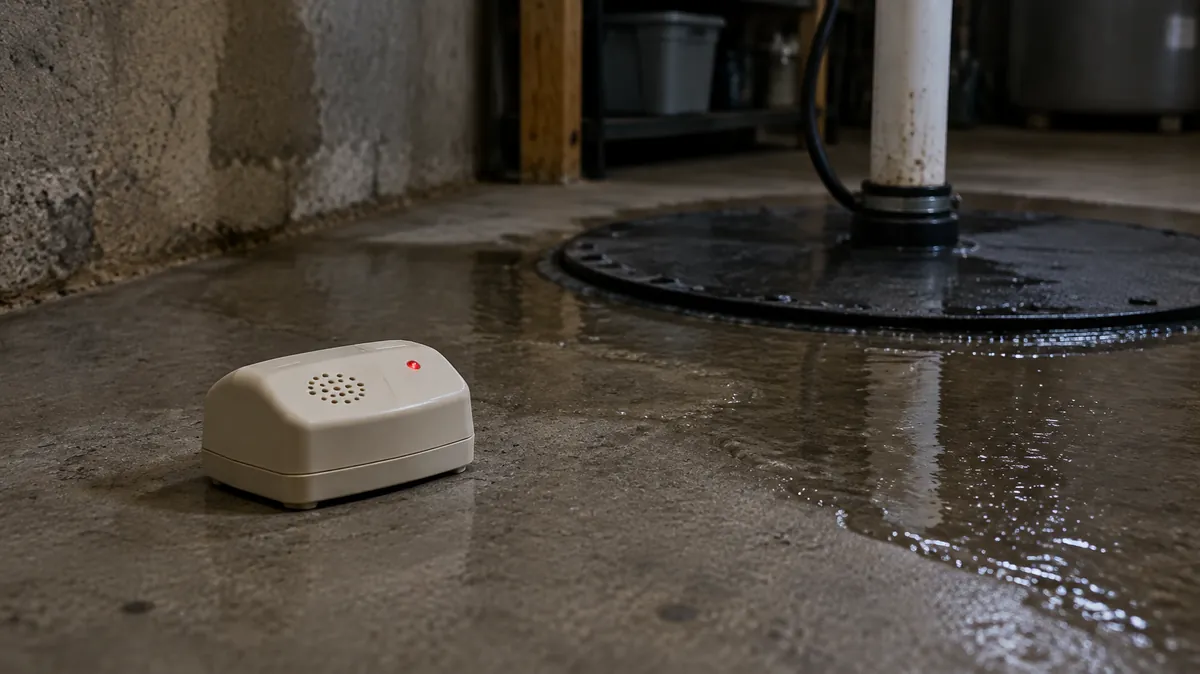
Buying guide · Published September 30, 2026

A basement floods quietly, at the lowest spot, usually while nobody is down there. A water alarm turns a slow flood into a noise you can hear. The real choice is between a loud alarm that works on its own and a smart sensor that texts you when you're away, and many basements need both.
Key takeaways
| Type | How it alerts | Works without Wi-Fi? | Best for | Example |
|---|---|---|---|---|
| Loud battery alarm | A siren on the unit, 90 to 110 dB | Yes | You're home most nights; simple setup | Basement Watchdog BW-WA360, Zircon Leak Alert |
| Wi-Fi sensor with siren | Phone alert plus a local siren | The siren does; phone alerts need Wi-Fi | Anyone who travels | Govee WiFi detector |
| Long-range hub sensor with siren | App alert plus a siren | The siren does | Big or concrete basements, outbuildings | YoLink alarm bundle |
| Sump pit alarm | A float or probe in the pit | Varies by model | Basements with a sump pump | See our sump pit sensor guide |
Moen notes that its main-line shutoff can't prevent flooding from outside causes such as heavy rain or a sump pump overflow. Those are exactly the leaks a basement alarm is for.
A small alarm with a 110 dB siren and a design that senses water on any side. The listing says it detects as little as 1/32 inch of water and measures about 2 3/8 by 1 by 3 1/4 inches. At around $20, it's easy to put one at every risk point.
Battery-powered alarms that sound at 90 dB when they get wet. The listing says the unit floats and keeps signaling for up to 72 hours in a flood. It runs on a 9V alkaline battery, which isn't included, and needs no setup.
A hub, two leak sensors and a 110 dB wireless siren on YoLink's long-range LoRa radio, which suits basements and spots with weak Wi-Fi. Device-to-device pairing means it can work with a YoLink valve controller even if your internet is down.
Connects straight to 2.4 GHz Wi-Fi with no hub, and backs up its phone notification with a local alarm loud enough to hear from another room. A low-cost way to cover a sump area, a water heater and a washer. For more budget options, including SwitchBot, see our budget leak detector guide.
Our printable placement checklist and placement guide go room by room.
A water alarm doesn't pump water out or stop it. If your basement floods because the sump pump fails during a storm, you also want power for the pump: see our sump pump battery backup guide and why sump pumps stop working. For a house that sits empty, add an automatic shutoff. See best smart water shutoff valves.
FAQ
For a simple, loud alarm, the Basement Watchdog Compact (110 dB) is a strong low-cost choice. If you travel, add a Wi-Fi sensor such as Govee's, or a long-range system like YoLink's for large or concrete basements.
No. A battery alarm sounds on its own. Wi-Fi only matters if you want phone alerts when you're away.
Look for at least 90 dB so it can be heard through a floor. The Basement Watchdog and YoLink bundle listings cite 110 dB sirens, and the Zircon listing cites 90 dB.
At least one at each risk point: the sump pit area, the water heater, the washer and the lowest part of the floor. Most basements end up with several.
On the floor beside the pit, so it sounds before water reaches stored items. Use a waterproof sump sensor for inside the pit, and see our guide to those sensors.