Comparison · Published September 28, 2026

Both watch every drop of water entering your house, and both will text you when something looks like a leak. The difference is what happens next. Flume tells you. Moen Flo tells you and closes the valve. That one difference drives everything else: the install, the price, whether renters can use it, and whether your insurer cares.
Key takeaways
| Flume (2 / 2X) | Moen Flo Smart Water Shutoff | |
|---|---|---|
| How it installs | Straps onto the outside of your water meter; no tools, no plumbing | Cut into the main cold water line; plumber recommended |
| Can it shut off water? | No | Yes, automatically or from the app |
| How it detects leaks | Reads your meter's flow and flags unusual patterns | Flow, pressure and temperature, plus a periodic MicroLeak pressure test |
| What it watches | Everything past the meter, including irrigation | Everything downstream of where it's installed |
| Renter-friendly? | Yes, fully removable | No |
| Compatibility | About 95% of US residential meters (check yours first) | ¾″ and larger models; sized to your home |
| Power | Battery sensor at the meter; plug-in bridge indoors | Wall outlet; optional battery backup for up to ~4 hours |
| Subscription | Not needed for leak alerts | Optional FloProtect (about $5/month): extended warranty and deductible guarantee |
| Insurance discounts | Rarely | More likely; confirm with your carrier |
| Rough all-in cost | Around $150–$250 | Device about $600 at list (Moen lists the 3/4-inch Flo Shutoff at $623.99); plumber install quotes vary widely, see our cost guide |
Prices move often and bundles change. Treat these as ballparks and check current listings. For a full breakdown of what installation can run, see our smart water shutoff valve cost guide.
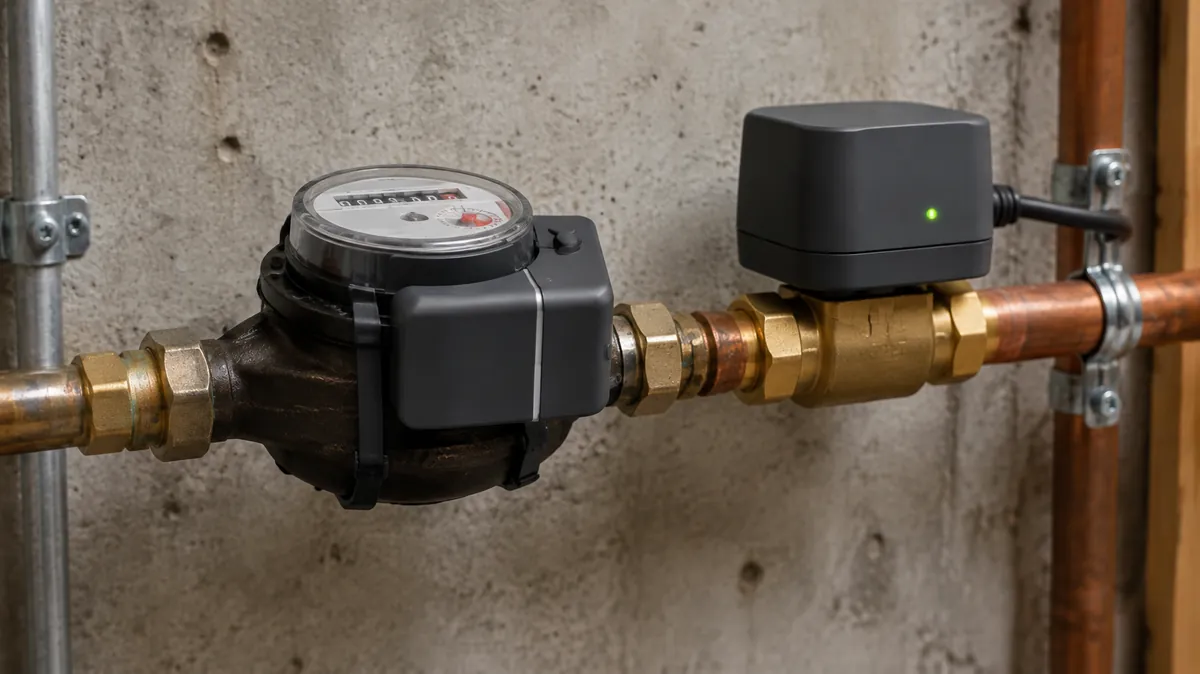
Flume doesn't touch your pipes at all. The sensor straps onto your water meter and reads the meter's internal magnet as it turns, then sends that data over a long-range radio to a small bridge plugged in inside the house, which passes it to the app over Wi-Fi. Because it reads the meter itself, it sees every gallon your utility bills you for, indoors and out. It learns your normal patterns and alerts you to things like water running continuously at 3 a.m. or a sudden high flow that doesn't stop.
Moen Flo sits in the pipe. It measures flow, pressure and water temperature directly, and it periodically runs a MicroLeak test: it briefly closes the valve and watches for a pressure drop, which reveals very small leaks like a dripping fixture or a pinhole in a pipe. When it sees something serious, it can close the valve on its own and send alerts. Moen says the unit keeps its learned settings locally, so it continues protecting the house if Wi-Fi drops.
Neither one tells you where the leak is. Both tell you that water is flowing when it shouldn't be. Finding the source is still up to you, and our guide to finding a hidden leak covers that part.
Flume's blind spot is obvious: it can't stop anything. If a supply line bursts while you're on a plane, you'll know within minutes, but someone still has to get there and close the valve.
Flo's blind spot is subtler. It only sees water that passes through it, and it's usually installed where the main line enters the house. Anything upstream of that point, such as an underground leak in the line between the meter and your house or an irrigation system that branches off before the Flo, is invisible to it. Flume, sitting on the meter, sees all of that.
That's why some homeowners run both: Flume for whole-property visibility, including the yard, and Flo for automatic shutoff inside the house. It's more than most people need, but it isn't redundant.
Flume is a genuine 10-minute job for most people: open the meter lid, strap the sensor on, plug in the bridge somewhere indoors, and pair it in the app. The catch is meter compatibility. Flume says it works with about 95% of US residential meters, but some newer solid-state and ultrasonic meters, including the Badger E-Series, Neptune Mach 10 and Sensus iPerl, aren't compatible. Check your meter with Flume's online tool before you buy. Some water utilities also offer Flume at a discount or with a rebate, so check with yours first.
Moen Flo means shutting off the water, cutting out a section of the main line, and fitting the valve with the correct adapters. A competent plumber usually does it in a couple of hours. Experienced DIYers can do it, but a mistake here affects the whole house. Our DIY vs. professional install guide covers what goes wrong.
| Model | Status | What changed |
|---|---|---|
| Flume (original) | Discontinued | First version; reviewers reported signal and battery-life limitations |
| Flume 2 | Still sold | Larger sensor, roughly double the battery life, and a much stronger wireless link to the bridge |
| Flume 2X | Current model | Parylene-coated electronics for weather protection, an upgraded Wi-Fi chip, and standard AA battery packs instead of a proprietary pack |
If you have an original Flume and it's working, there's no urgent reason to replace it, but signal drops are the usual reason people upgrade. Between the 2 and the 2X, the 2X is the better buy if the price gap is small, mainly for the tougher sensor and standard batteries. If the Flume 2 is on a deep discount, it still does the same core job.
The one to get if you own the home and want the water to shut itself off. The periodic MicroLeak test is a genuinely useful health check for slow leaks you'd never see.
The easiest whole-home leak alert you can buy: no plumber, no cut pipes, and it moves with you. Good irrigation and outdoor visibility, too.
Prefer the previous model? The Flume 2 is still widely available and often discounted. For the full field, including Phyn Plus, see our smart water meter guide and Moen Flo vs. Phyn Plus.
If Flume doesn't fit your meter, or you want a strap-on style device with more options, a few alternatives exist: clamp-on ultrasonic flow monitors that attach to an exposed section of pipe instead of the meter, and hub-based systems that pair a small inline flow meter with an automatic shutoff valve. They're newer and less proven than Flume or Flo, so check recent reviews and compatibility with your pipe size before buying. And whichever whole-home device you choose, a few point sensors at the water heater, washer and sinks are still worth having as a backup that works without Wi-Fi.
FAQ
Flume straps onto your water meter and sends leak alerts based on your water use, but it can't shut off the water. Moen Flo is installed inline on your main water line and can shut off the water automatically when it detects a leak.
Moen Flo is better if you own the home and want automatic shutoff. Flume is better if you rent, can't modify your plumbing, want to watch irrigation and outdoor lines, or want leak alerts at a much lower cost.
No. Flume is a monitor only. It alerts you to unusual flow, but someone has to close the valve. For automatic shutoff you need an inline valve like Moen Flo or Phyn Plus.
Flume 2X is the newer model. It adds parylene-coated electronics for better weather protection, an upgraded Wi-Fi chip, and standard AA battery packs instead of a proprietary pack. The core leak detection and usage tracking are the same.
Flume says it works with about 95% of US residential meters, but some solid-state and ultrasonic meters, such as the Badger E-Series, Neptune Mach 10 and Sensus iPerl, are not compatible. Check your meter with Flume's compatibility tool before buying.
Yes. Flume watches everything past the meter, including irrigation and the line into the house, while Flo provides automatic shutoff inside the house. It's more than most homes need, but the two don't overlap completely.