Drying Out After Water Damage · Published September 26, 2026
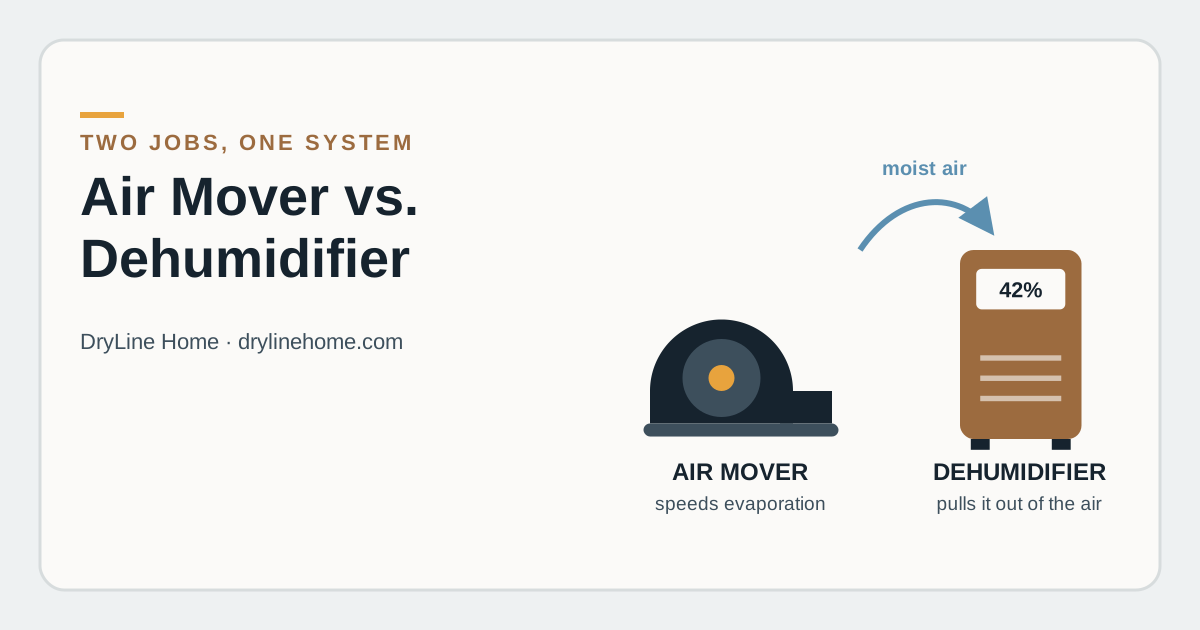
An air mover gets water out of wet materials and into the air. A dehumidifier gets it out of the air and down a drain. They do opposite halves of the same job, which is why running one without the other either crawls along or quietly makes things worse. Here's how each works, how to set them up, and what's realistic for a homeowner to buy or rent.
Key takeaways
| Air mover | Dehumidifier | |
|---|---|---|
| Job | Speeds evaporation from wet surfaces | Removes water vapor from the air |
| Removes water from the room? | No | Yes, into a bucket or drain |
| Alone, it will... | Raise room humidity; drying stalls | Dry slowly, mainly surface moisture |
| Placement | Low, aimed along floors and wall bases | Central in a closed room, with a drain line |
| Consumer version | Compact carpet-drying fans | 50-pint home dehumidifiers |
| Pro version | High-velocity centrifugal and axial units | LGR refrigerant and desiccant units |
Every bit of water an air mover evaporates ends up as humidity. In a closed room without dehumidification, humidity climbs until the air is close to saturated. At that point evaporation slows to a crawl, and the damp air starts moving into things that were dry: drywall in the next room, wood furniture, trim, books. Restoration pros call this secondary damage, and it's the reason no professional drying setup runs air movers without dehumidifiers.
The reverse is less harmful but slow. A dehumidifier alone will lower the room's humidity, but without airflow across wet surfaces, water inside materials evaporates slowly. You need both working together to hit the EPA's 24 to 48 hour window for drying before mold becomes a risk.
Sizing and running costs for home units are covered in our basement dehumidifier cost breakdown.
For a one-time leak, renting often makes more sense. Many equipment rental shops and home improvement stores rent air movers and commercial dehumidifiers, which are far more capable than consumer versions. Call ahead, because they get booked up after storms.
Buying makes sense for things you'll keep using. A good home dehumidifier earns its place in any basement year-round, and a compact air mover is handy for spills, wet carpet, and drying a basement after a sump problem. If the job is big enough that you're thinking about renting four air movers and two LGR units, it's usually big enough to have a professional look at it.
We haven't lab-tested these; these are the categories and units we'd look at based on specs and what the restoration trade uses.
FAQ
An air mover blows high-velocity air across wet surfaces to speed up evaporation, turning water into humidity. A dehumidifier removes that humidity from the air and sends it to a bucket or drain. Drying water damage needs both.
Not reliably. Fans without dehumidification raise the room's humidity until drying stalls, and the damp air can soak into materials that were dry, causing secondary damage.
Restoration pros often start at roughly one air mover for every 10 to 16 feet of wet wall, plus extra for wet floor area. For a homeowner drying a single wall or small room, one or two is usually enough alongside a dehumidifier.
Low to the floor, angled so the airflow runs along the base of the wet wall or across the wet floor rather than pointing straight at it. Multiple units can be arranged to circulate air in one direction around the room.
Renting commercial air movers and dehumidifiers is often better value for a one-time leak. Buying makes sense for a home dehumidifier you'll use year-round in a basement and a compact air mover for occasional spills.