Drying Out After Water Damage · Published September 26, 2026

Can You Dry Water Damage Yourself? When Fans and a Dehumidifier Are Enough
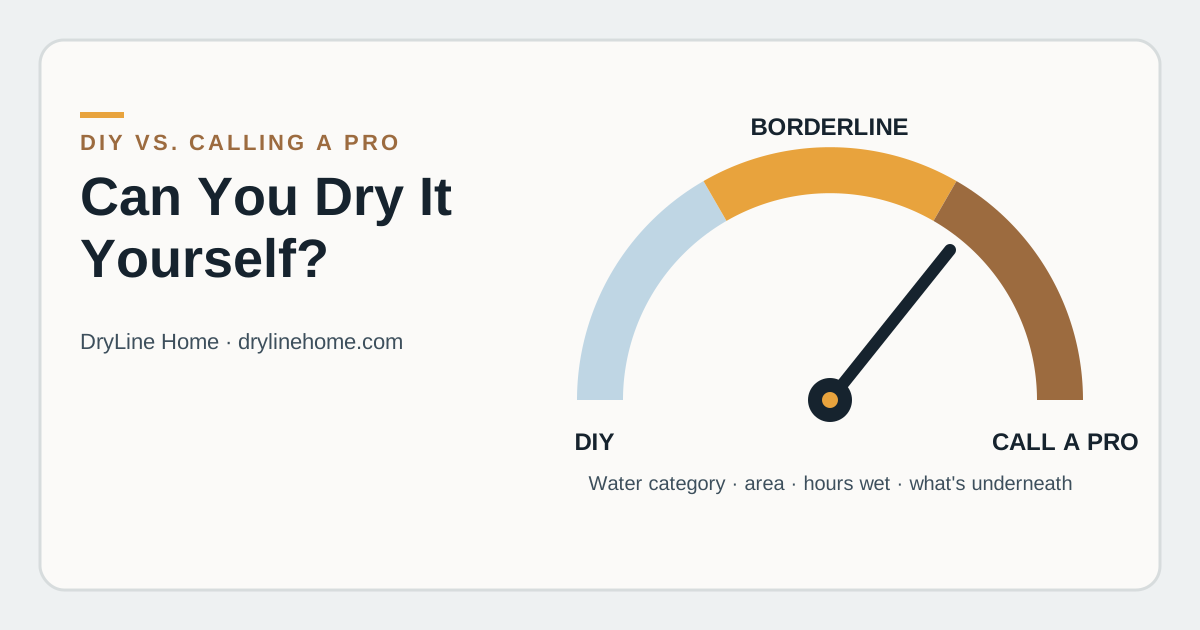
Gauge dial running from DIY-friendly through borderline to call a professional
Illustration: DryLine Home

Sometimes, yes. A clean-water spill on a hard floor that you caught within an hour or two is a very reasonable DIY job. Water that got into walls, under flooring, or came from a sewer line usually isn't, and not because the pros have magic fans. It's because you can't see when it's done without the right meters, and guessing wrong is how mold happens.

This article contains affiliate links. We may earn a commission at no extra cost to you — see our full disclosure.

Key takeaways

  • DIY works best for small, clean-water spills caught quickly on surfaces you can see.
  • Fans alone don't dry a room. Without a dehumidifier, evaporated water just becomes humidity that soaks back into other materials.
  • Call a pro for dirty water, ceilings, wall cavities, soaked carpet pad, hardwood, or anything wet longer than a day.
  • A basic moisture meter, usually well under $100, is the tool that makes DIY drying honest: it tells you whether readings are actually coming down.
  • Flooded basements can be pumped out yourself, but finished basements and groundwater or sewer flooding usually need professional drying.

The quick decision checklist

Go through these honestly. If everything lands in the left column, you can probably handle it. Any item in the right column is a good reason to get a professional in, and two or more make it an easy call.

Probably fine to DIYCall a drying company
Clean water: supply line, sink, rainSewage, toilet overflow with waste, outside floodwater
Found within a few hoursSat wet for more than a day, or you don't know how long
One room, mostly on the surfaceSeveral rooms, or water came through a ceiling
Hard floors: tile, sealed concrete, vinyl on concreteCarpet with a soaked pad, hardwood, laminate, subfloor
Drywall wet only at the very bottom edgeWicking several inches up the wall, or water inside wall cavities
You can measure moisture and see readings dropNo meter, or readings stay flat after 2–3 days

Will fans and dehumidifiers solve the problem?

They can, as long as you use both together. The most common DIY mistake is a few box fans pointed at a wet wall in a closed room. The fans do speed up evaporation, but the water has to go somewhere. Without a dehumidifier it becomes humidity, the room climbs toward saturation, and drying stalls. Meanwhile, that damp air starts getting absorbed by drywall, wood trim and furniture in the rest of the space.

Consumer equipment also has limits. A household dehumidifier is sized to hold a basement at a comfortable humidity level, not to pull out gallons of water from a soaked room. Professional LGR dehumidifiers are built for exactly that job and keep working as the air gets drier. Air movers push a focused, fast stream of air along the floor and wall base, which a box fan or pedestal fan doesn't do well.

So the honest answer: for a small area, a good home dehumidifier plus a couple of fans aimed correctly will get the job done. For a large area or anything inside walls, consumer gear is often too slow to beat the 24 to 48 hour window the EPA gives for preventing mold growth. Here's how air movers and dehumidifiers differ if you're deciding what to buy or rent.

How much moisture is too much to handle yourself?

There's no single number, but there are good rules of thumb. Surface water on a hard floor is easy. Water that got into something is where DIY gets risky. A few signs that you're past the easy stage:

That last one is the most reliable. See how to check for moisture inside walls for how to take those readings properly.

Can a flooded basement be dried without professional help?

It depends on how it flooded and what's down there. Pumping out standing water yourself with a utility pump or a shop vac is fine. An unfinished basement with a concrete floor and block walls is the most DIY-friendly space in the house, because there's very little porous material to hold water.

A finished basement is a different story: carpet, pad, drywall, insulation and framing all sitting at the lowest point of the house, often in cool temperatures where drying is slow. Add groundwater or sewer backup and the water is contaminated, which means porous materials generally need to come out rather than be dried. That's professional territory.

If your basement floods regularly, our guides on sump pumps vs. waterproofing and sump pump battery backups cover stopping the next one.

How to set up DIY drying properly

  1. Extract first. Shop vac every bit of standing water you can. This does more than hours of fan time.
  2. Close the room. Shut doors and windows (unless it's clearly drier outside) so the dehumidifier is working on one space.
  3. Run the dehumidifier continuously with a hose to a floor drain or sink, or a unit with a built-in pump, so it doesn't stop when the bucket fills.
  4. Aim fans low. Air should skim across the wet floor and the bottom of wet walls, not blow at the ceiling.
  5. Open things up. Pull baseboards off wet walls, open cabinet doors, remove toe kicks, take up area rugs.
  6. Measure daily. Take readings at the same marked spots each day and compare them with a dry area of the same material.
  7. Keep going until readings match the dry area, not until it feels dry. Then keep the dehumidifier running another day.

What you'll need

If you're drying a small area yourself, here's the minimum kit. These are general category links rather than specific models, since the right size depends on your space:

Common DIY drying myths

FAQ

Common questions

Can I DIY water damage restoration or do I need a professional?

You can usually handle a small, clean-water spill that you caught within a few hours, especially on hard floors. Call a professional for contaminated water, water in ceilings or wall cavities, soaked carpet pad, hardwood floors, or anything that stayed wet for more than a day.

Will fans and dehumidifiers solve my water problem?

Together, for a small area, often yes. Fans alone don't: they turn water into humidity, and without a dehumidifier that moisture soaks back into other materials. Large or deep-soaked areas usually need professional-grade equipment to dry within the 24 to 48 hour window.

How much moisture is too much to handle myself?

Signs you're past DIY include drywall that's soft or wet several inches up, a squishy carpet pad, cupping hardwood, a growing ceiling stain, a musty smell after a day or two, or moisture readings that stay well above a dry reference area.

Can flooded basements be properly dried without professional help?

An unfinished concrete basement with clean water often can. A finished basement with carpet, drywall and insulation, or any flooding from groundwater or sewer backup, generally needs professional drying and removal of contaminated materials.

Do I need a moisture meter to dry water damage myself?

It's strongly recommended. Surfaces dry long before the materials underneath, and a meter is the only practical way for a homeowner to know whether readings are actually returning to normal before closing things up.

Related reading

More on this topic