Drying Out After Water Damage · Published September 26, 2026

How Long Does Structural Drying Take, and How Do You Know It's Done?
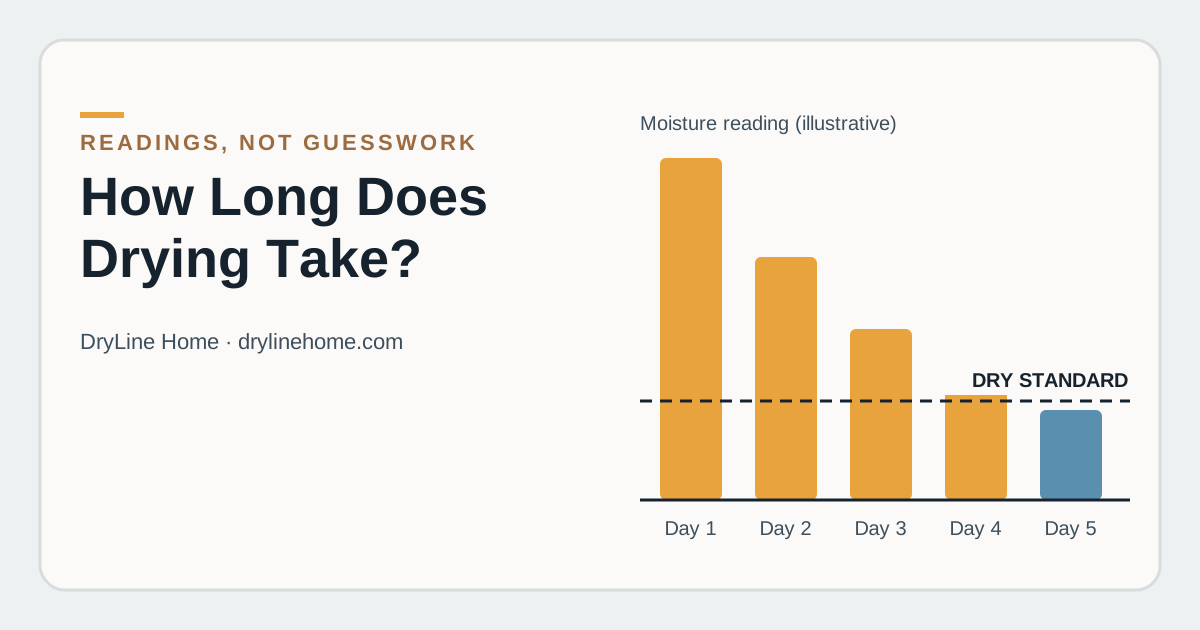
Illustrative bar chart of moisture readings falling day by day until they reach the dry standard line
Illustration: DryLine Home

For a typical clean-water leak in drywall and carpet, professional drying usually takes around three to five days. Dense materials like hardwood, plaster, and concrete can take one to several weeks. But the real answer is "until the readings say it's dry," and that's worth understanding, because pulling equipment a day early is one of the most common ways a small leak turns into a mold problem.

Key takeaways

  • 3–5 days is typical for drywall, framing and carpet with professional equipment and clean water.
  • Hardwood, plaster, concrete and brick hold water deeply and often take a week or more.
  • Temperature, humidity, airflow, and how quickly drying started matter more than anything else.
  • Moisture should be checked daily, at the same marked spots, and written down.
  • Drying is done when wet materials match an unaffected area of the same material, not when they feel dry.

Typical drying times by material

These are rough ranges for clean water with proper equipment running from the start. Contaminated water, delays, cold spaces, or undersized equipment all push them longer.

MaterialTypical drying timeWhy
Drywall (wet at the base)2–4 daysThin and porous; dries quickly once air reaches both sides
Carpet (pad removed or extracted)1–3 daysFibers dry fast once the water underneath is gone
Wood framing and plywood subfloor3–5 daysAbsorbs more water and releases it more slowly
Hardwood flooring1–3 weeksDense; needs specialty mats and slow, controlled drying to avoid cracking
Plaster and lath1–2 weeks+Much denser than drywall
Concrete slab or blockWeeksHolds water deep inside; dries mostly from one surface

What affects how long drying takes

How often should moisture be monitored during drying?

At least once a day. Professional drying crews map the wet area on day one, mark specific reading points on walls and floors, and come back every day to record readings at the same spots, along with the room's temperature and humidity. That log does three jobs: it shows whether drying is progressing, it tells the crew when to move or remove equipment, and it documents the job for the insurance company.

If you're drying something yourself, do the same thing on a smaller scale. Put small pencil marks where you take readings, write the numbers down each day, and note the room humidity from a cheap hygrometer. If readings stop dropping for two days in a row, something's wrong: not enough dehumidification, a hidden pocket of water, or the leak isn't actually fixed.

How do you know when structural drying is complete?

The professional standard is called the dry standard: a reading taken from an unaffected area of the same material in the same house. Drywall in a dry bedroom, for example, tells you what normal looks like for the drywall in the wet hallway. Drying is complete when the wet materials read the same as, or very close to, that reference.

This matters because moisture meters don't give universal "dry" numbers. A reading of 12 on one meter setting means something different on drywall than on pine framing, and normal levels vary with climate and season. Comparing like with like, same material, same meter, same setting, sidesteps all of that.

A few other signs that it's done: readings have plateaued at the dry-standard level for a day, the room humidity is back to normal once the dehumidifier is off, and there's no musty smell. Only then should walls be closed up, baseboards reinstalled, or anything painted.

Why stopping early is the expensive mistake

The surface of a wall dries first. Paint and the paper face of drywall can feel completely dry while the gypsum core, the bottom plate of the wall, or the subfloor is still wet. Pull the equipment, reinstall the baseboard, and that remaining moisture is now sealed in a dark cavity at room temperature, which is exactly the environment mold needs. See how mold develops after water damage for the timeline.

How humidity is measured during restoration

Homeowners are used to relative humidity (RH), the percentage on a typical hygrometer. Restoration pros also track grains per pound (GPP), which measures the actual amount of water vapor in the air regardless of temperature. That's useful because RH changes when temperature changes even if no moisture was removed; GPP only drops when water is actually leaving the air. Comparing GPP going into and coming out of a dehumidifier is how a pro checks the unit is doing real work.

For DIY purposes, RH is fine. Keep an eye on it and aim for it to fall steadily; if a dehumidifier is running and RH isn't moving, the unit is undersized or the room isn't closed off.

FAQ

Common questions

How long does structural drying take?

Typically about three to five days for drywall, framing and carpet with clean water and professional equipment. Hardwood, plaster and concrete often take one to several weeks. Delays, cold rooms and contaminated water make it longer.

How do temperature and humidity affect drying time?

Warm, dry air speeds drying because it can absorb more moisture and warm materials release water faster. High humidity or cold rooms slow evaporation sharply, which is why dehumidifiers and temperature control matter as much as fans.

How often should moisture be monitored during drying?

At least once a day, at the same marked spots, along with room temperature and humidity. If readings stop falling for two days, something needs to change, such as more dehumidification or finding a hidden wet area.

How do I know when structural drying is complete?

When moisture readings in the affected materials match readings from an unaffected area of the same material in the same house, known as the dry standard. Surfaces feeling dry to the touch isn't a reliable sign.

Can I put baseboards back and paint once the wall feels dry?

Not until moisture readings confirm the materials are back to the dry standard. Surfaces dry first; sealing in a still-wet core or bottom plate creates ideal conditions for mold.

Related reading

More on this topic