Drying Out After Water Damage · Published September 26, 2026
Mold spores are already in every house, floating in the air and settled on surfaces. They don't need to be brought in. They just need moisture, something to feed on, and time. Water damage supplies the first two instantly. Drying is how you take away the third, and the EPA's guidance is to get water-damaged materials dry within 24 to 48 hours to prevent mold growth.
Key takeaways
Mold is a normal part of the outdoor environment and its spores are in indoor air all the time. It becomes a problem when spores land on something that's wet and edible. After a leak, the house is suddenly full of both: the paper facing on drywall, wood framing and subfloor, carpet backing, ceiling tiles, cardboard boxes, even the dust in a wall cavity.
Warm, still, dark spaces speed things up. That's why mold after water damage so often shows up in places nobody looked: behind baseboards, inside wall cavities, under carpet pad, and on the back side of drywall. The room side of the wall can look clean while the cavity behind it is growing.
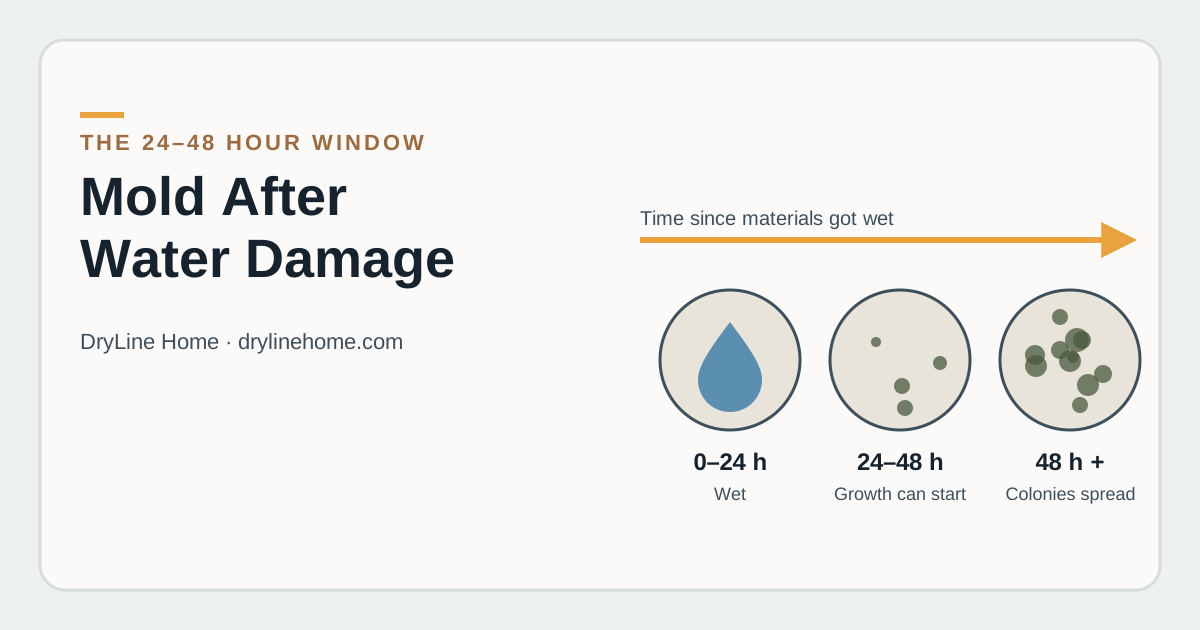
| Time since materials got wet | What's typically happening |
|---|---|
| First 24 hours | Materials are wet. Fast drying here prevents almost all mold issues. |
| 24–48 hours | The window the EPA gives for drying to prevent mold growth. Growth can begin, especially in warm, humid, closed spaces. |
| Several days | Visible growth and musty odor become common on materials that stayed wet. Clean-water losses start behaving like contaminated ones. |
| A week or more | Growth spreads into cavities and porous materials; removal rather than drying becomes the usual approach. |
These aren't precise deadlines. Temperature, humidity, and the material all change the pace. But the direction is always the same: every day of delay makes the job bigger. If you're at hour one right now, our first 48 hours guide is the place to start.
Yes, and that's largely the point of doing it quickly and properly. Mold can't grow on materials that are dry. Getting wet materials back to their normal moisture level inside the 24 to 48 hour window removes the one ingredient mold can't do without.
What drying can't do is undo growth that's already there. Drying a moldy wall stops the mold from spreading further, but the growth stays on the material. At that point the job becomes cleanup (for hard, non-porous surfaces) or removal (for porous materials like drywall, insulation and carpet pad). That's why restoration companies push so hard on speed: a same-day drying job is almost always cheaper than a mold remediation job three weeks later.
The EPA's general guidance is that if the moldy area is less than about 10 square feet (roughly a 3 ft by 3 ft patch), most homeowners can clean it themselves. Hard surfaces can be scrubbed with detergent and water and then dried completely. Porous materials like drywall, ceiling tiles and carpet that have grown mold usually need to be removed and replaced, because mold grows into them rather than sitting on the surface.
The EPA doesn't recommend bleach or other biocides as a routine part of mold cleanup; the real fix is removing the growth and the moisture. Wear an N-95 respirator, gloves, and eye protection while cleaning. Call a professional for anything larger than about 10 square feet, for mold in the HVAC system, for mold caused by sewage or other contaminated water, or if anyone in the household has health concerns. The EPA's Brief Guide to Mold, Moisture and Your Home is a good plain-language reference.
FAQ
Mold spores are already present in all homes. After water damage, wet materials like drywall paper, wood, carpet backing and dust give them the moisture and food they need, and if materials stay wet beyond about 24 to 48 hours, growth becomes likely.
Stop the water, extract standing water quickly, dry with dehumidifiers and air movers rather than fans alone, open up hidden spaces like baseboards and toe kicks, remove materials that can't be dried in time, and confirm dryness with a moisture meter before closing anything up.
Yes. Mold can't grow on dry materials, so drying wet materials within the 24 to 48 hour window largely prevents it. Drying doesn't remove mold that has already grown, which then needs cleanup or removal.
Common results include hidden mold, wood rot in framing and subfloor, flooring that cups or buckles, permanently swollen cabinets and trim, persistent musty odor, and potential problems with insurance coverage for gradual or mold-related damage.
The EPA suggests most homeowners can handle areas smaller than about 10 square feet, cleaning hard surfaces with detergent and water and replacing moldy porous materials. Larger areas, HVAC contamination, or mold from sewage or contaminated water should be handled by a professional.